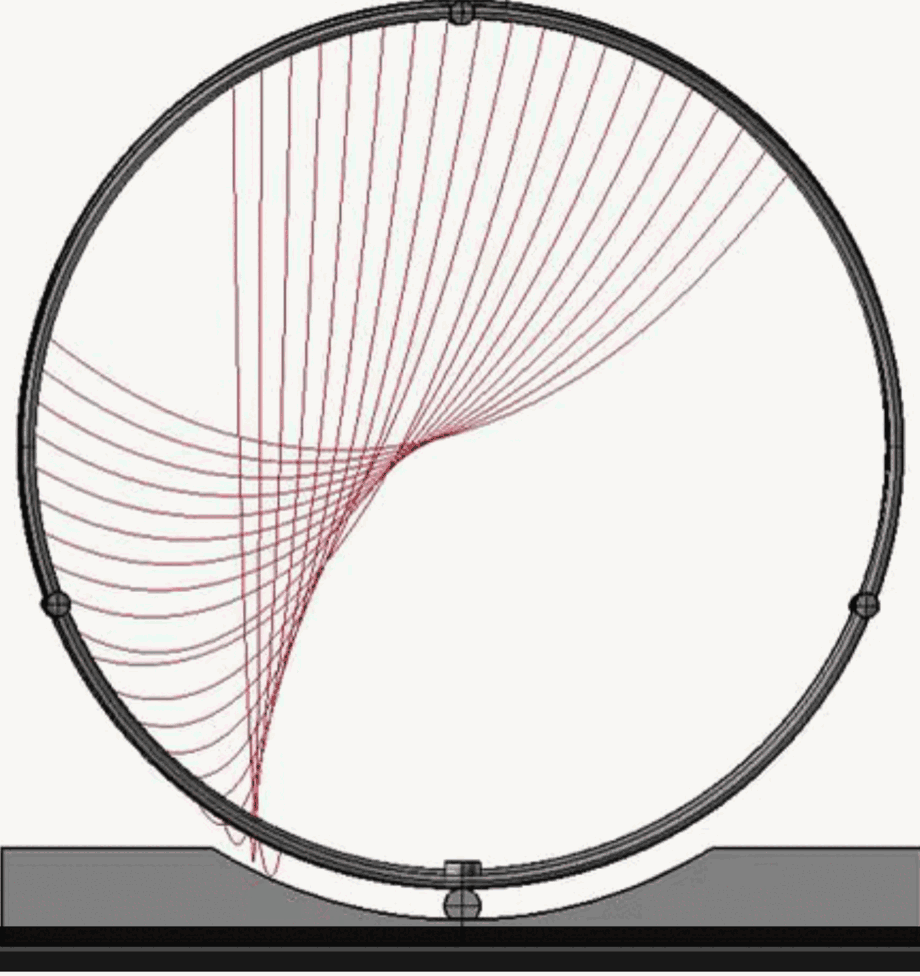
Catenary Software
A catenary is the curve described by a hanging chain or cable, supported only by its ends. Huygens coined the word in 1690 from the Latin, catena, a chain. Mathematically, the catenary is the graph of the hyperbolic cosine.
Galileo, writing in 1638, said a hanging rope was almost a parabola. In 1691, the Bernoulli brothers, Leibniz and Huygens finally derived the equations for the catenary.
The catenary curve is everywhere. Every telephone line going from pole to pole hangs in a catenary curve. Spider webs, simple suspension bridges, the St. Louis Gateway Arch is a modified inverted catenary. Engineers refer to the catenary as a funicular curve and railroad tracks are designed to curve in this manner. Hanging springs are elastic catenaries.
The catenary curve is a natural shape. Writing to Thomas Paine about the construction of an arch for a bridge, Thomas Jefferson said:
I have lately received from Italy a treatise on the equilibrium of arches, by the Abbe Mascheroni. It appears to be a very scientifical work. I have not yet had time to engage in it; but I find that the conclusions of his demonstrations are, that every part of the catenary is in perfect equilibrium. It is a great point, then, in a new experiment, to adopt the sole arch, where the pressure will be equally borne by every point of it. If any one point is pushed with accumulated pressure, it will introduce a danger, foreign to the essential part of the plan.
Perfect equilibrium. We like that idea. Our solutions are bridges, arches reliably communicating the right information to the right people, the right way. Each end point gets its data as it wishes to see it and can send what data it can furnish in the manner it wishes.
The logo was designed by Kevin Pazik.
Data First. The real world is described in data, not merely process and promises.
Honor thy User. Unless everyone from owner to end user understands and participates in the solution, it only becomes a problem.
An excellent consultant makes minimal changes and never tries to tell the client how to run his own business. It is the hallmark of the idiot that he wants to redo everything.
Of studie took he moost cure and moost heede.
Noght o word spak he moore than was neede,
And that was seyd in forme and reverence,
And short and quyk, and ful of hy sentence;
Sownynge in moral vertu was his speche,
And gladly wolde he lerne, and gladly teche.
He took utmost care and heed for his study.
Not one word spoke he more than was necessary;
And that was said with due formality and dignity
And short and lively, and full of high morality.
Filled with moral virtue was his speech;
And gladly would he learn and gladly teach.
— Chaucer's Clerk